
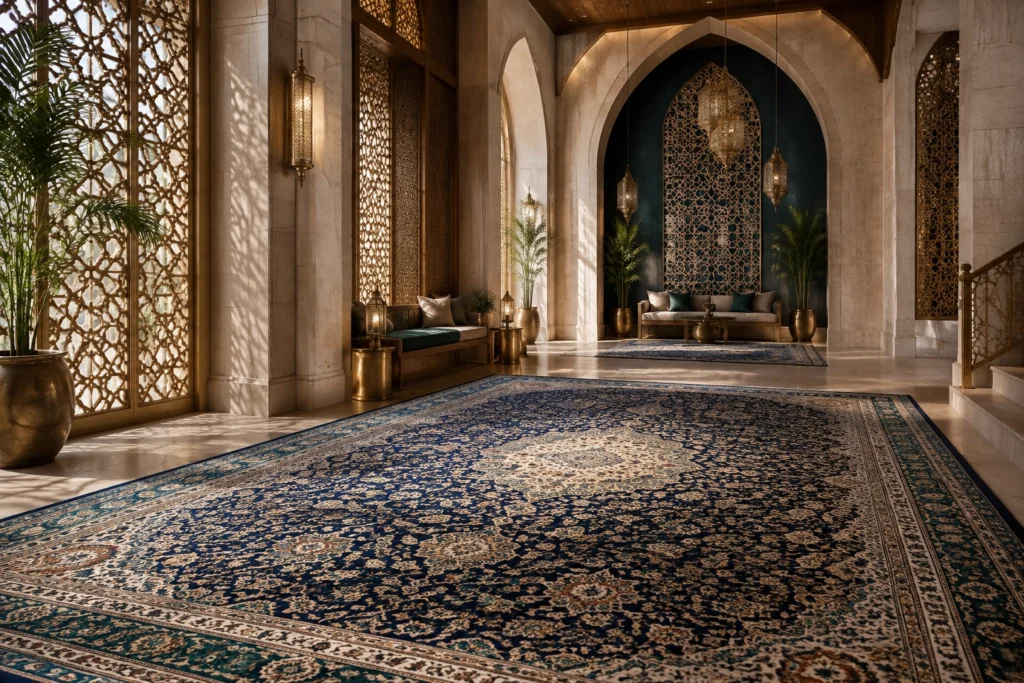
The market for carpets in Islamic nations is one of the most strategic, yet complex landscapes for machine-woven carpet manufacturers. Unlike Western markets, which primarily prioritize aesthetic trends, this market is deeply intertwined with culture, tradition, faith, and specific architectural standards. For any exporter or importer seeking sustainable presence in this region, understanding the specific needs of carpet export to Islamic countries is not merely an option—it is a vital necessity. In this comprehensive article, we dissect the market, analyze product technicalities, examine customs standards, and explore the key role of Senobar Carpet in fulfilling these unique demands.
The market in Islamic countries cannot be viewed as a single, uniform entity. To succeed in carpet export to Islamic countries, one must categorize the market into three distinct hubs:
This region—comprising Saudi Arabia, the UAE, Qatar, and Kuwait—demands high-end, premium-quality carpets due to massive investments in infrastructure, hospitality, and residential projects. Here, a carpet is not just floor covering; it is a display of wealth and architectural grandeur. The focus is on large-scale designs, high-density weaving, and luxurious materials.
In countries like Egypt, Morocco, and Algeria, the market is a blend of traditional and modern demands. These regions prefer classic designs with warmer color palettes and competitive pricing.
Countries such as Indonesia and Malaysia are emerging markets for machine-woven carpets featuring modern, lighter designs, driven by rapid economic growth and urban development projects.
In the process of carpet export to Islamic countries, product design must be in harmony with the region’s cultural codes.
Geometric patterns and arabesque motifs in Islamic culture symbolize order, infinity, and unity. Buyers in these regions prefer carpets that convey a sense of peace and spirituality. Senobar Carpet, understanding this deep connection between art and religion, reproduces a wide range of authentic designs using modern technology, ensuring that traditional integrity meets contemporary machine-woven quality.
While European trends often favor cool, neutral tones (like grey and white), many Islamic markets prefer warm color palettes—such as gold, cream, crimson, and royal blue. These colors harmonize better with the traditional lighting and interior architecture characteristic of these regions.
A professional importer looks beyond aesthetic appeal; they seek a product capable of enduring the region’s harsh environmental conditions.
Many target countries, especially in the Persian Gulf, experience hot, arid, or highly humid climates. This presents two challenges:
Senobar Carpet maintains rigorous quality control at every stage—from yarn selection to final finishing—producing items with exceptional resistance to environmental degradation.
Importers must be familiar with national standards in the destination country. For instance, entering the Saudi Arabian market requires strict adherence to SASO standards. These regulations mandate precise testing regarding material toxicity, fire resistance, and packaging. Failing to comply can result in customs seizures and significant financial loss.
Success in carpet export to Islamic countries relies on robust supply chain management.
In the highly competitive international market, B2B buyers prioritize “Supply Security.” Senobar Carpet, leveraging years of experience in the Kashan machine-woven carpet industry, ensures this security through:
Q1. Are Senobar machine-woven carpets suitable for mosques?
Yes, we produce a specialized collection of non-directional and prayer-mat designs with appropriate density and easy-maintenance features for religious projects.
Q2. How can we ensure color fastness against direct sunlight?
All our products undergo rigorous light-intensity and color-fastness testing to ensure they do not fade in regions with high solar exposure.
Q3. What is the Minimum Order Quantity (MOQ) for bulk projects?
We offer flexible conditions based on the project type (commercial vs. residential). Customization of design and color is available for large-scale developments.
The market for carpet export to Islamic countries offers unparalleled opportunities for forward-thinking brands. However, entering this arena without technical expertise, cultural insight, and a specialized supplier is fraught with risk. By focusing on technical standards, respecting local tastes, and partnering with a reputable entity like Senobar Carpet, you can ensure long-term success in these high-potential markets.
Are you ready to expand your market presence in Islamic countries?
Contact Senobar Carpet’s specialized experts today to receive your exclusive catalog and discuss partnership terms for international projects.

One Response