
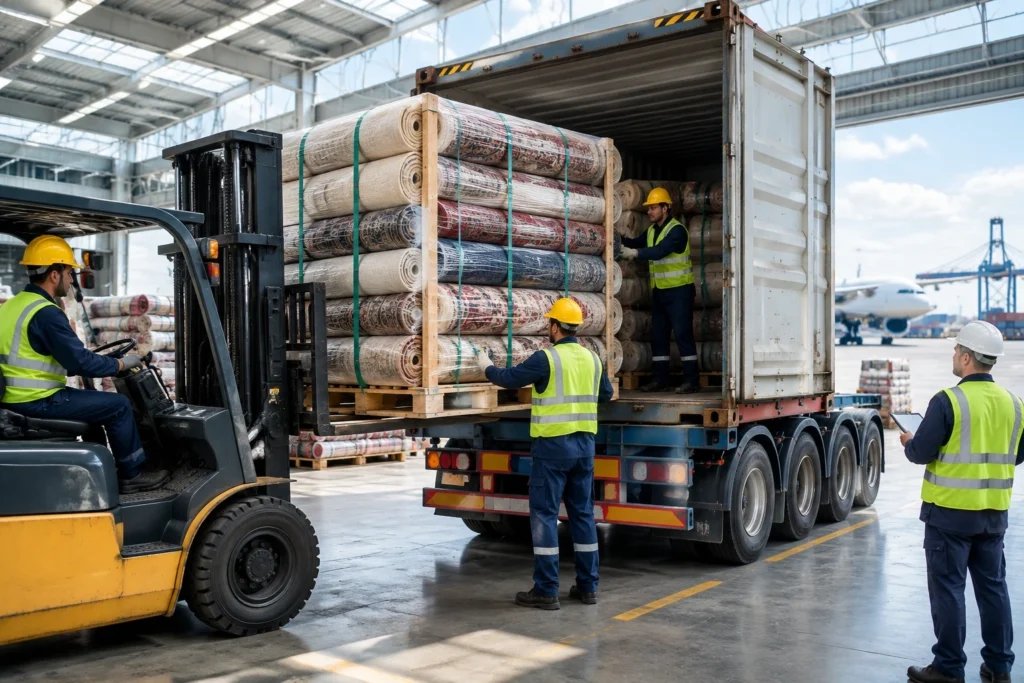
A carpet may leave the factory in perfect condition, yet arrive at its destination with damaged packaging or an unpresentable appearance after several stages of loading, warehouse stops, border crossings, and unloading. For this reason, production quality alone is not enough to satisfy an international buyer; the quality of delivery matters too. International Carpet Shipping should be planned while the order is being prepared—not after the cargo is already waiting to depart.
Choosing a route is only one part of that plan. Packaging, transit time, the number of times the cargo will be handled, storage conditions, shipping documents, insurance, and each party’s responsibilities can all affect the outcome. This guide covers the main considerations for International Carpet Shipping, from pre-loading preparations to delivery at the destination.
Start by identifying what is being shipped, in what quantity, and for what type of buyer. The dimensions and weight of each carpet, yarn composition, backing construction, and sensitivity to pressure or moisture all affect packaging and loading decisions. A large order for an importer may require a different plan from a few samples sent for the buyer’s review.
Record the delivery address precisely as well. Delivery to a port or terminal is not the same as delivery to the buyer’s warehouse; the final leg may require a separate vehicle, unloading arrangements, and additional coordination. International Carpet Shipping is more reliable when the entire route—from the loading point to the agreed delivery location—is clearly defined. Senobar Carpet Factory emphasizes that understanding the destination and the customer’s needs is an important first step toward a smooth shipment.
No single shipping method is best for every order. The buyer’s expected delivery time, cargo volume, available routes, and total cost should be considered together. Comparing carriers by their initial quoted rate alone can be misleading: intermediate handling, storage, and inland delivery at the destination may add to the final cost.
Sea freight is often considered for larger orders, but the total delivery time is not limited to the vessel’s time at sea. Transport to the port, waiting for loading, possible transfers along the route, and destination procedures should all be included in the schedule. For sea-based International Carpet Shipping, inspect the container before loading and consider the possibility of moisture exposure during the journey.
Road freight may be worth considering for destinations with suitable road connections. Its practical advantages depend on the actual route: will the cargo travel in the same vehicle close to its destination, or will it be unloaded and reloaded at borders or terminals? Each additional handling stage calls for extra care during handover. For road-based International Carpet Shipping, ask about the number of stops and whether reloading is expected.
If the buyer needs a few samples before making a decision, or the delivery deadline is particularly tight, air freight may be an option. However, compare the cost with the dimensions and weight of the packages, the carrier’s cargo requirements, and the expense of getting the shipment to its final destination. With International Carpet Shipping, a faster flight does not necessarily mean faster final delivery.
Good packaging should protect the carpet from pressure, abrasion, dirt, and route conditions without making the order difficult to identify. Before wrapping, check that the carpets are clean and dry, their edges are intact, and the products match the order. Rolling or stacking should also suit the product and the limits of the chosen transport method.
For heavy packages, do not focus only on the strength of the outer covering. If the cargo will be handled with a forklift or warehouse equipment, the lifting method and the package’s support surface matter too. In International Carpet Shipping, packaging is not successful merely because the carpet looks neat when it leaves the factory; it should remain effective throughout the journey.
A carpet that is packed while damp or stored in a humid area may arrive with an unpleasant odor or signs of damage. Temperature changes during transit can also increase the risk of moisture forming inside a closed space. Before loading, inspect the floor and walls of the container or cargo area, and do not place packages on wet or contaminated surfaces.
The type of wrapping, ventilation approach, and use of moisture-control materials should depend on the journey’s duration, route conditions, and packaging design. One solution will not suit every shipment. In International Carpet Shipping, preventing moisture problems is usually easier than handling a dispute after damaged goods reach the buyer.
Even suitable packaging cannot compensate for poor loading. Packages should be positioned so that weight is not concentrated unevenly on a few rolls and the cargo cannot shift during braking, turning, or normal vehicle movement. Before closing the vehicle or container, check for empty spaces, pressure from other cargo, and contact with rough or dirty surfaces.
For container shipments, the person responsible for loading should distribute weight and secure the cargo in a way that suits the packages. For containerized sea freight, the verified gross mass of the container must also be provided in accordance with applicable requirements. Taking photos of the load and package condition before sealing is a useful part of managing International Carpet Shipping.
The buyer should be able to identify each package without opening it. The order number, product code, quantity, dimensions, or other agreed details should be legible and consistent with the packing list. If a shipment includes several designs or sizes, clear coding can make counting and delivery more efficient.
Before dispatch, compare the invoice, packing list, transport documents, and actual cargo details. Required documents depend on the origin and destination countries, the shipping method, and the sales agreement, so confirm the document list for the specific order with the carrier and customs representative. In International Carpet Shipping, a mismatch between the number of packages shown in the documents and the actual count can make the shipment harder to track.
Wood packaging may be subject to treatment and marking requirements on some export routes. Before choosing pallets, crates, or wooden cargo bracing, check the destination’s regulations and the carrier’s acceptance requirements. Failing to check these details can create a problem unrelated to the quality of the carpet itself.
Before the cargo moves, the buyer and seller should know who is responsible for each cost and stage: transport to the terminal, loading, main carriage, insurance, import procedures, unloading, and delivery to the final address. The selected trade term and the specific place of delivery should be stated in the agreement. Naming only a city or using a general phrase such as “delivery at destination” may not be enough to prevent a dispute.
Do not treat freight costs, the point at which risk transfers, and the obligation to arrange insurance as if they were the same issue. They can vary according to the agreed trade term. In International Carpet Shipping, clarifying these details before payment and dispatch can help prevent disagreements if a delay or damage occurs.
Knowing that “the shipment is insured” is not enough. Confirm who arranges the insurance, where coverage begins and ends, which risks it covers, and what evidence is required to report a claim. The declared value of the goods and the packaging details should also match the information provided to the insurer.
Keep useful records of the goods before packing, the completed packages, the loading process, and the sealed cargo. If damage is found at the destination, documenting the condition before fully unpacking the goods may help establish what happened. Insurance does not replace careful handling in International Carpet Shipping, but it is an important part of managing shipment risk.
The departure time given by a carrier is not necessarily the date when the carpet will reach the buyer. Preparing the order, booking capacity, moving cargo to a terminal, export procedures, possible delays, and destination handling all affect the overall schedule. During negotiations, distinguish between the order-ready date, the departure date, and the estimated delivery window.
For orders needed before an exhibition, store opening, or sales season, allow a reasonable time buffer. A promise based only on the fastest possible scenario can become difficult to keep after a routine change along the route. A good International Carpet Shipping plan gives the buyer a realistic picture of the journey.
The work does not end once the cargo leaves. Save the tracking number or transport-document details, estimated milestones, and the contact information of the person responsible for follow-up in the order file. If the shipment is delayed at a point along the route or the estimated arrival time changes, inform the buyer early so they can prepare to receive and unload it.
At the destination, receipt should include counting the packages and checking their visible condition. Agree in advance on whom the buyer should contact and how soon to report possible damage. This follow-up is the final stage of International Carpet Shipping and is just as important as planning the route.
Choosing the cheapest quote without checking the route and included services is a common mistake. A lower main-carriage rate may be offset by more handling, a longer transit time, or unexpected destination charges. Another mistake is treating all carpets alike and using the same packaging method for orders with different sizes, materials, or routes.
Failing to record the cargo’s condition before loading, using labels that do not match the documents, and leaving responsibilities unclear can also make disputes harder to resolve. To reduce these risks, think of International Carpet Shipping as a set of connected decisions rather than simply booking a vehicle or vessel.
Before handing the cargo to the carrier, review these points:
This checklist does not replace checking the requirements of a specific destination, but it can help prevent key International Carpet Shipping details from being overlooked during a busy loading day.
Successful export delivery is not the result of a single decision. The shipping method, cargo protection, safe loading, document coordination, clear responsibilities, and follow-up to the destination all need to work together. When each stage of International Carpet Shipping is planned in advance, the risk of damage, delays, and disagreements about the order’s condition is reduced.
Senobar Carpet Factory can also use records from each shipment—from packaging choices to the condition of the goods at delivery—to improve its shipping procedures for different routes. Ultimately, success in International Carpet Shipping means more than getting the cargo to its destination: the carpet should arrive safely, be easy to identify, and be ready for handover to the buyer.
