
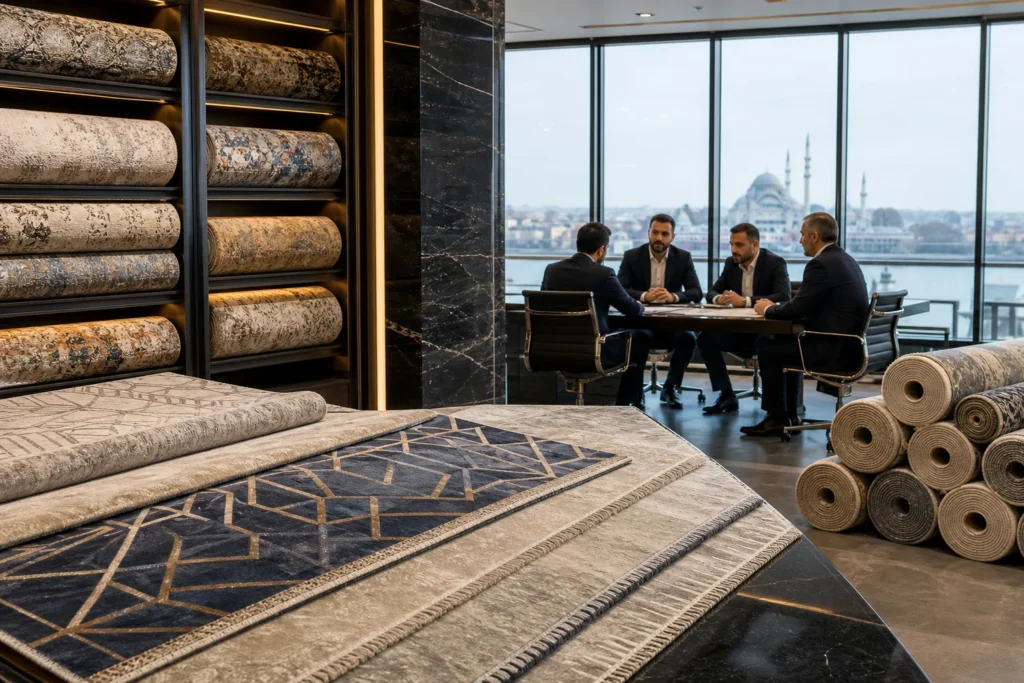
The global carpet market is a ruthless arena of competition, yet it remains filled with untapped opportunities. Turkey, as one of the world’s leading production hubs, stands as a dominant player, dictating price trends across the Middle East and Europe. For many Iranian manufacturers and exporters, exporting machine-made carpets to Turkey is not merely a commercial challenge; it is a significant test of competence, artistic integrity, and the added value of Iranian goods in a neighboring market.
Leveraging its industrial hub in Gaziantep, Turkey has brought mass production standards to a global level. But is there a place for Iranian brands in this competitive field? The answer is a resounding “Yes”—provided we move away from traditional patterns and adopt a strategy rooted in deep market analysis and “specialization.”
Local manufacturers in Turkey, utilizing state-of-the-art German and Belgian weaving machinery, have successfully supplied the Middle Eastern and European markets with highly competitive pricing. They are undeniably powerful in the mass production model. However, the competitive landscape in Turkey still contains niches that Iranian brands can fill by relying on “art, finesse, and originality in design.” To succeed in exporting machine-made carpets to Turkey, you must understand that we should not play on their home turf. Low-cost mass production is the specialty of Turkish manufacturers. Our winning strategy lies in focusing on the luxury sector, high-density carpets, and classic-modern designs that are rarely found in standard, integrated Turkish machine-made production.
To establish a firm foothold in our neighbor’s market, adopting the following operational strategies in the process of exporting machine-made carpets to Turkey is essential:
Iranian brands must move away from generic, repetitive mass-market products. Focus on fusion (traditional-modern) designs that align with specific, upscale interior decor trends. Demand is rising in Turkey for carpets that possess a distinct “identity.” Turkish interior designers are actively searching for carpets that are unique—this is exactly where Turkish mass producers fall short.
Using high-purity fibers and advanced technologies for color stabilization and “hand-look” weaving can create the necessary economic justification for wholesalers and chain furniture stores in Turkey. If a Turkish buyer is convinced that the tactile quality and durability of an Iranian carpet offer superior value, they will easily shift away from domestic products.
The Turkish market is heavily reliant on B2B relationships. Establishing direct contact with Turkish Carpet Exporters’ Associations, interior design firms in Istanbul and Ankara, and utilizing digital B2B trading platforms is far more effective than relying on traditional trade fairs. Furthermore, building rapid logistics infrastructures (such as regional warehouses in border cities) for timely delivery is your greatest trump card against competitors whose supply chains are limited to within Turkey.
Among the leading companies in this arena, Senobar Carpet leverages the technical expertise of internal specialists and utilizes the world’s most advanced weaving machinery to create products that meet the strict quality standards required to penetrate demanding regional markets. By understanding the true needs of the international market, Senobar Carpet has fine-tuned its production process to rival the world’s finest not only in technical quality and pile density but also in aesthetic elegance. Senobar Carpet’s focus on obtaining international quality certifications is a key factor in facilitating the process of exporting machine-made carpets to Turkey, securing the trust of international wholesalers.
The future of the carpet trade in Turkey is tied to the shifting lifestyles of the middle and upper classes, who are increasingly drawn toward authentic and luxury goods. Therefore, exporters who can combine the visual identity of Iranian carpets with modern technological standards will not only survive the competition with local manufacturers but can also capture a significant share of the market. Exporting machine-made carpets to Turkey is an opportunity for Iranian brands to step out of the shadows and establish their true standing among international markets. This path requires patience, understanding consumer taste, and consistency in quality—which will undoubtedly result in foreign currency revenue and the strengthening of the national brand.
Turkey has strict regulations on textile imports to protect domestic production. Exporters must be aware of preferential tariffs and utilize valid commercial documents (such as Certificates of Origin and standard compliance). Consulting with customs brokers specialized in the Turkish market is the first step to reducing hidden costs. Contact our experts for guidance on navigating these regulations.
No; the Turkish market is two-layered. The lower tier competes on price (dominated by local Gaziantep producers), while the luxury and mid-range tiers are hungry for different designs, high quality, and pattern originality. Iranian brands must enter the second tier directly and avoid competing in the low-cost commodity market.
Beyond attending specialized trade fairs (such as Domotex Turkey), collaborating with interior design agencies and building project designers is the best channel. These individuals are your bridge to luxury residential and hotel projects looking for exclusive carpets.
Senobar Carpet provides detailed technical identification for every product, including real density, fiber type, and product health warranties, along with the option to send samples. This transparent approach eliminates purchase risk for the Turkish buyer.
Absolutely. B2B markets in Turkey rely heavily on online searches. Having a specialized website in Persian, English, and Turkish signals to the Turkish buyer that you are a professional manufacturer with export capacity, not a small intermediary. Contact us today to learn how we can help you expand your business reach.
