
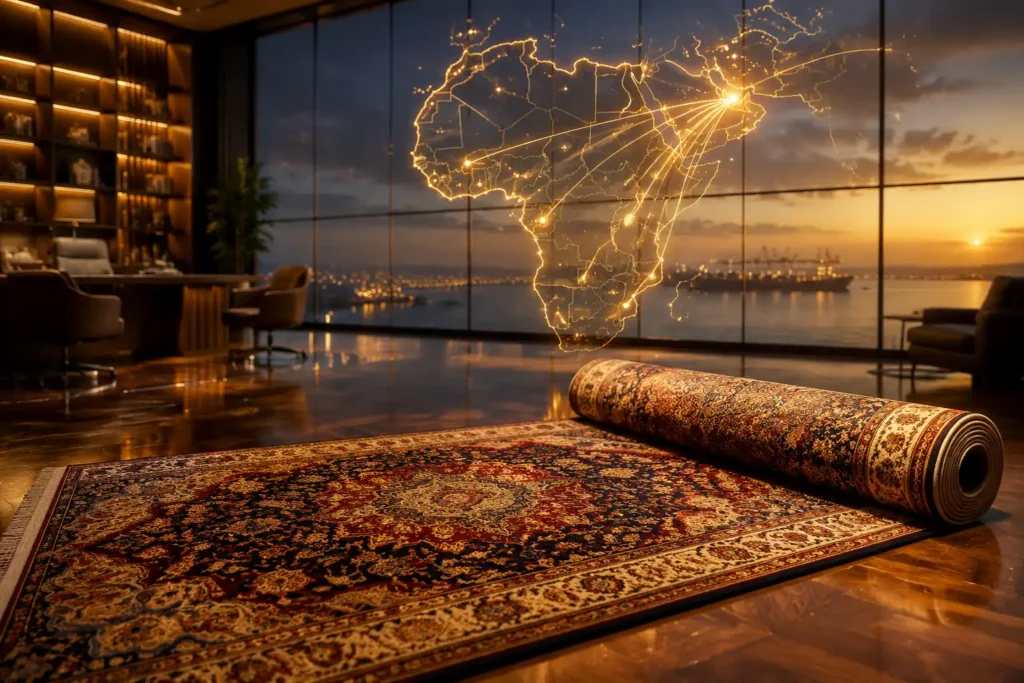
Over the past decades, the attention of many Iranian business owners has mainly been focused on neighboring markets or Europe. Today, however, geopolitical and economic developments across Africa have created a fertile ground for the growth of Iranian brands. Exporting machine-made carpets to Africa is no longer just an option; it is a market penetration strategy for forward-looking companies seeking a share in emerging economies.
With a population of more than 1.4 billion people and a rapidly expanding middle class, this continent has a growing demand for high-quality interior decoration products. Senobar Carpet Company, recognizing this reality, has developed a precise plan for sustained presence in this market. In this article, we take a close and strategic look at this path.
Contrary to common assumptions, Africa is not a single unified market. It is a continent made up of diverse markets with different tastes, purchasing power, and cultural preferences.
Southern African countries, especially South Africa, have modern infrastructure and living standards similar to Western countries. In this market, exporting machine-made carpets to Africa becomes meaningful when focused on modern, minimalist, and high-density heat-set carpets. Luxury hotels and upscale villas in this country are among the main buyers of high-quality Senobar carpets.
Nigeria, as the most populous country in Africa, has extremely high demand for machine-made carpets at competitive prices. In these markets, carpets are not just floor coverings; they are also symbols of social prestige. By offering products in attractive color ranges and authentic Iranian-inspired patterns that also align with local cultural preferences, Senobar Carpet Company has been able to attract the attention of Nigerian wholesale traders.
Kenya, due to its strategic port position, especially Mombasa, is considered a gateway to East African markets. Infrastructure development and construction investments in this region have created consistent demand for office, hotel, and residential carpets.
To succeed against Chinese, Indian, and Turkish manufacturers, product quality is the first deciding factor. African traders are looking for products that can withstand different climate conditions, including high humidity in some areas and intense heat in others.
One of the biggest challenges in trading with Africa is logistical complexity. To succeed in this area, Senobar Carpet Company offers the following support to its partners:
If shipping costs are not managed properly, they can significantly increase the final price of the carpet. By using standard containers and contracts with shipping lines connected to major African ports, we reduce transportation costs.
Obtaining a Certificate of Origin and complying with the quarantine and import standards of each country are essential for smooth customs clearance. Senobar’s legal and export team has a strong understanding of African trade regulations and prepares all necessary documentation so that traders face no issues at the destination customs office.
To reduce financial risks, Senobar Carpet Company uses modern international banking payment methods and, when necessary, offers special terms to reliable distributors in Africa.
If you are a trader and want to enter the field of exporting machine-made carpets to Africa, follow this practical roadmap:
Yes. Due to growing demand and limited local production in many African countries, profit margins for high-quality Iranian machine-made carpets can be very attractive.
Modern carpets with neutral colors and classic Iranian carpets with traditional patterns for the luxury segment usually perform best.
Yes. Our export team manages the full process, including production, packaging, licensing, and delivery to the destination for customers.
The main challenges are logistics and currency fluctuations. Senobar minimizes these risks through careful supply chain management and strategic planning.
You simply need to contact our international trade department so that we can send you our export catalog and dealership cooperation terms.
Exporting machine-made carpets to Africa is a gateway to global market expansion for the Iranian carpet industry. By combining authentic Iranian artistry with modern manufacturing standards, Senobar Carpet Company has created a reliable platform for traders to enter this market with confidence. We believe that with the right strategy, it is possible to secure a significant share of this vast and promising continent.
Start today. If you are looking for a supplier that guarantees quality, price competitiveness, and supply consistency, Senobar Carpet Company can be your ideal business partner.
