
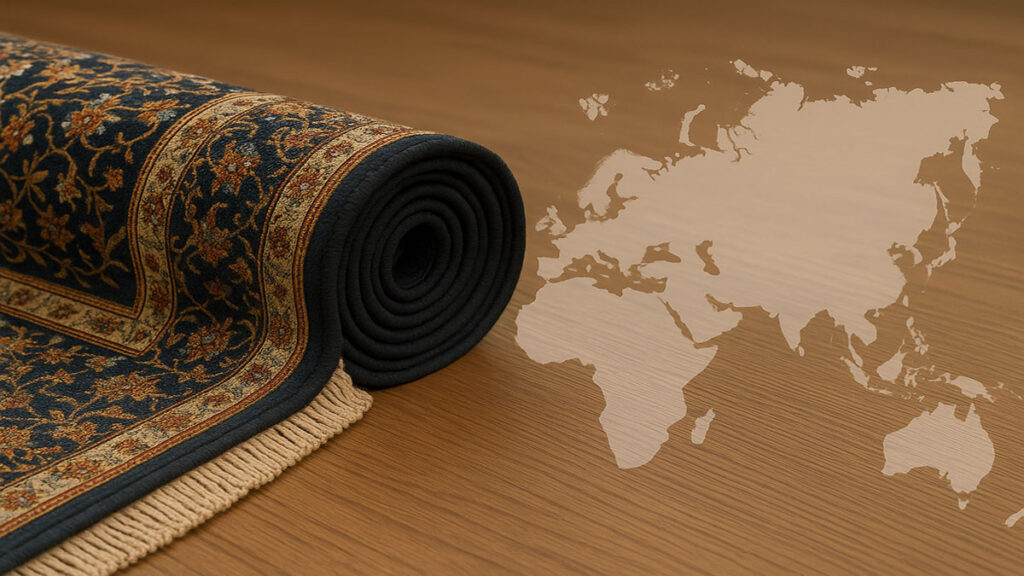
The export of machine-made carpets is not only one of Iran’s key non-oil industries, but also a reflection of the country’s art, culture, and industrial capabilities. With advancements in production technology, a variety of designs, and the use of high-quality fibers such as BCF yarn for 700-reed carpets or heat-set acrylic yarn for 1200-reed carpets, Iran is in a position to become a powerful player in the international machine-made carpet market. However, intense competition from countries like Turkey, India, China, and even some emerging producers shows that success in the global market is not solely dependent on product quality. It also relates to choosing the right target market, understanding consumer behavior, precise export policies, and implementing international marketing strategies.
Looking at global market trends in recent years and forecasting the economic and cultural behavior of countries in 2025, it is evident that some markets hold significantly higher potential for attracting Iranian carpets. Factors such as the growth of the middle class, lifestyle trends focused on beauty and decoration, lack of similar domestic production quality, and acceptable trade relations with Iran will pave the way for successful exports. Therefore, identifying and precisely analyzing these countries is crucial for any Iranian carpet manufacturer or trader.
This article, through an analytical approach based on market data, export experiences, and the study of consumer culture in different world regions, introduces and analyzes the best countries for exporting Iranian machine-made carpets in 2025. It also addresses the opportunities, challenges, and entry strategies for each market to help you make more informed decisions for expanding your exports.
Choosing the target country in carpet exports is the most critical step for a successful entry into international markets. Contrary to what some exporters may believe, having a high-quality product alone does not guarantee success. Instead, careful analysis of the destination market, understanding consumption patterns, and evaluating economic, cultural, and commercial data are what shape the future of exports.
Machine-made carpets, especially varieties like 700-reed BCF (which are more affordable and mass-market) and 1200-reed acrylic carpets (which are considered luxury), should be exported to countries where the consumption patterns, financial capacity, and purchasing behaviors match the product’s profile.
Below are the most important criteria to consider when selecting an export destination:
The first indicator to examine is the carpet consumption volume in a country. Nations with strong interior decoration cultures—where carpets are viewed not just as functional items but also as part of the visual identity of homes, offices, or public spaces—are excellent export destinations. For example, Gulf countries like the UAE or Qatar pay special attention to carpets and flooring in their interior design.
In populous countries like India and China, although price is a critical factor, the annual consumption of carpets and rugs is very high. Even if a small share of this demand is captured by Iranian carpets, it could result in considerable profits.
Market demand can be assessed through trade reports, local market research, annual carpet import statistics, and even user behavior on search engines.
The purchasing power of a country’s population plays a decisive role in the type of carpet suitable for export. In developed countries such as Canada, Germany, Japan, or Singapore, high prices are not a barrier if the product offers added value, unique design, and premium quality. Hence, exporting 1200-reed acrylic luxury carpets to these countries is justified.
On the other hand, in middle-income countries like Nigeria, Kenya, or Indonesia, consumers seek reasonably priced carpets with acceptable durability. In such markets, 700-reed BCF carpets are a better fit. Purchasing power can be evaluated through indicators such as GDP per capita, welfare index, inflation rate, and wage levels.
One often overlooked but critical factor in export success is the cultural perception of carpets in the destination country. In many nations—especially Islamic countries, Central Asia, and the Middle East—carpets are not just decorative goods but an integral part of life, prayer, hospitality, and traditional ceremonies. Thus, the acceptance of Iranian carpets is significantly higher.
In contrast, in some cultures like those of Scandinavia or Eastern Europe, flooring materials such as parquet or laminate are more common, and carpets are used in limited areas. Before entering a market, it is important to assess whether consumers use carpets at all, and if so, what type they prefer: traditional, modern, simple, colorful, or classic.
Political issues and trade relations between Iran and destination countries directly impact the success or failure of exports. Some countries, due to international sanctions or restricted relations with Iran, face serious challenges in money transfers, customs clearance, or even transport insurance. On the other hand, import tariffs vary widely. For example, in Turkey, the import tariff on Iranian carpets is very high, making competition difficult. However, in some African countries, tariffs are either low or favorable due to bilateral trade agreements.
To understand this clearly, resources like the ITC Trade Map or WTO databases can be consulted to review the import regulations of each country.
Some countries have highly competitive carpet import markets. For instance, Turkey, with its powerful machine-made carpet industry, dominates markets in neighboring and Muslim countries. China and India also offer extremely low prices, capturing large portions of markets in Africa and Southeast Asia. Entering these markets without a strong competitive advantage (such as unique design, superior quality, or brand recognition) is not easy.
Conversely, some markets are still underserved due to cultural or economic reasons. Markets like Kenya, Senegal, or even some Canadian provinces have high potential for Iranian carpet entry, especially when supported by strategic planning and marketing efforts.
A thorough analysis of these five key criteria—market demand, purchasing power, cultural consumption, customs regulations, and competition levels—must be conducted before any export decision. This analysis can be gained through market research, insights from experienced exporters, consultation with logistics firms, and feedback from international customers. Without this analysis, carpet export becomes a gamble; with it, the chances of success multiply.
Once the target market selection criteria are understood, the next step is to identify specific countries that are economically, culturally, and commercially suitable for the entry of Iranian carpets.
Given the structural changes in the global economy, rising competition from Asian producers, and the digitalization of distribution channels, 2025 will be a decisive year for Iranian exporters. Some countries stand out due to their cultural affinity for carpets, strong purchasing power, or low competition.
Here are six strategic and high-potential markets for 2025:
(UAE, Qatar, Oman, Kuwait, Bahrain)
These countries, part of the Gulf Cooperation Council, are among the easiest and most profitable markets for Iranian carpet exports due to their concentrated wealth and luxury-focused lifestyles. Consumers here prefer unique, cultural products. Iranian carpets—especially 1200-reed acrylic carpets with classic designs—have a special place in luxury villas and aristocratic homes.
Iran’s geographical proximity to these countries reduces transportation costs and delivery time. International exhibitions in Dubai, Sharjah, and Doha provide great opportunities for marketing and attracting wholesale clients.
Entry Strategy:
With a population of over 1.4 billion, India is one of the largest consumer markets in the world. The use of carpets in homes is deeply rooted in traditional and religious households. Despite being a carpet producer itself, Iranian carpets are appreciated by the upper middle class for their cultural and historical value.
The main challenge is price sensitivity and competition with local producers. Therefore, 700-reed BCF carpets with simpler designs are better suited for this market.
Success Tips for India:
As one of the world’s strongest economies and largest consumer markets, China’s interest in traditional design and cultural products creates a strong base for Iranian carpet exports. 1200-reed acrylic carpets with classic Iranian designs are used as focal decorative items in modern Chinese homes.
China’s market is heavily digital. Most consumers shop on platforms like JD.com or Alibaba, making online entry not just possible but essential.
Opportunities & Suggestions:
Canada is a stable economy with an open market and a diverse immigrant population including Iranians, Arabs, Afghans, and Indians—who are familiar with carpet culture. Additionally, native Canadians appreciate artistic and cultural products, making Iranian carpets attractive.
Although Canadians are used to online shopping, decorative products like carpets are still sold through physical or consultative retail.
Recommended Strategy:
(Nigeria, Kenya, South Africa)
Though Africa might not seem like a prime carpet market, its economic growth, urbanization, and lack of domestic high-quality production have created demand in some regions. Nigeria and Kenya, as major hubs in West and East Africa respectively, offer a good platform for economic carpet exports.
Carpets are used in homes, mosques, schools, businesses, and offices. Price sensitivity is high, but bulk sales with acceptable quality can be profitable.
Export Strategy:
(Indonesia, Malaysia, Thailand)
This region has seen significant growth in construction, tourism, and interior decoration over the past decade. Locals are highly interested in Eastern traditional designs and luxury spaces. The hotel industry in places like Bali and cities like Bangkok requires uniquely designed carpets.
Cultural awareness is essential in this market—color schemes should be bright and cheerful, and designs should not be overly intricate.
Recommendations:
Each country has unique characteristics, and exporting carpets without deeply understanding these differences is ineffective. Some countries like the UAE and Canada are better for luxury carpets and branding, while others like India, China, and Nigeria respond better to affordable, mass-produced options.
Choosing the Right Country = Higher Success Probability + Lower Financial Risk
(Comprehensive Guide to Iranian Machine-Made Carpet Export: Criteria and Market Selection)
Successful exporting is never a result of chance; it is the outcome of careful decision-making based on data analysis and deep market understanding. In this article, we learned that before any attempt to export Iranian machine-made carpets, several key factors must be considered—from market demand, consumer purchasing power, and carpet culture to import tariffs, political relations, and competition.
Understanding these elements helps exporters determine what product to send to which country, at what price, and under what conditions. For instance, Gulf countries with high purchasing power are suited for luxury carpets, while markets like Africa or India require more affordable designs. Matching product features to market demands is the golden rule of export success.
Additionally, we saw that some countries, despite appearing attractive demographically or culturally, may not be ideal due to high tariffs or existing competitors. Conversely, seemingly less attractive countries may prove highly profitable with proper planning.
Therefore, analyzing these criteria should be the starting point for any export plan. It not only reduces financial and commercial risks but also provides a clearer, more accurate roadmap for success.
