
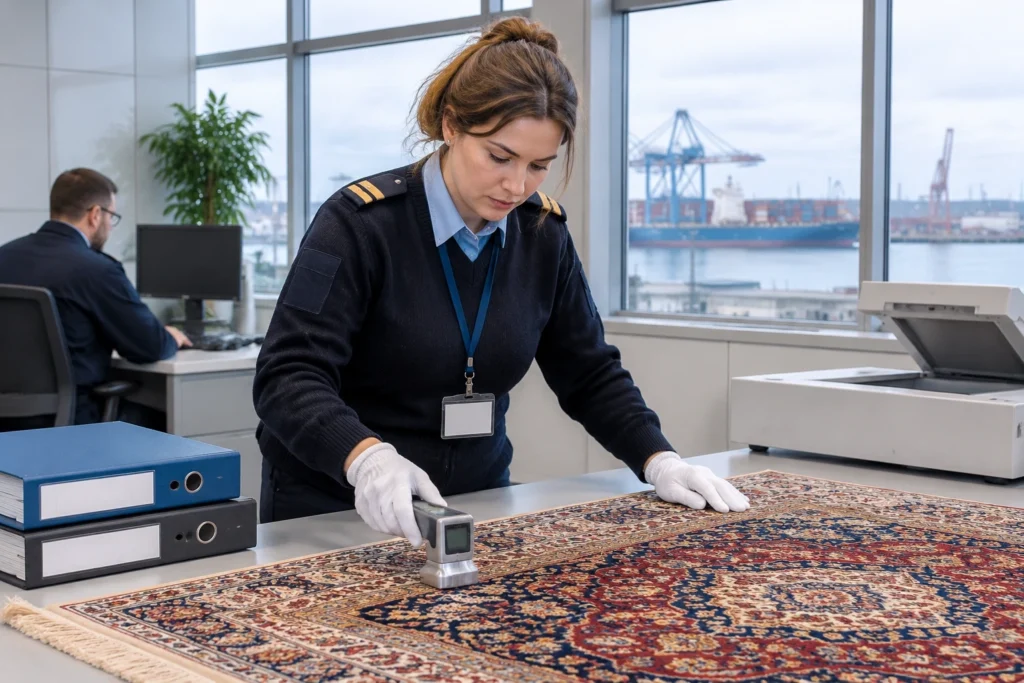
The European Union represents a diverse and highly competitive market for carpet manufacturers; however, successful market entry depends on far more than attractive designs, weaving quality, and competitive pricing. Before dispatching any shipment, exporters must understand how carpets are classified under tariff codes, what product information must be displayed, and which party bears the responsibility for customs clearance and expenses. Familiarity with EU carpet import regulations and tariffs ensures realistic pricing and prevents shipments from being delayed due to documentation errors or specification discrepancies.
It is vital to recognize that “carpets” do not constitute a uniform customs category. Hand-knotted rugs, woven machine-made carpets, tufted floor coverings, and other textile floor coverings fall under distinct classifications. Furthermore, distinctions must be maintained between customs duties, import value-added tax (VAT), and logistics and clearance costs. This article examines EU carpet import regulations and tariffs comprehensively, guiding exporters from initial product identification to document preparation and final delivery to the buyer.
In commercial imports, a designated company or responsible entity within the European Union typically submits the customs declaration. This process requires registering importer information and obtaining an EORI customs identification number. Upon arrival, customs authorities inspect the product code, value, and origin, subsequently releasing the goods for free circulation within the EU market provided all conditions are met.
Consequently, EU carpet import regulations and tariffs cannot be summarized by simply asking, “What is the carpet duty percentage?” The definitive answer depends on exact carpet specifications, the country of origin, the time of declaration, and the specific member state of entry. Exporters are strongly advised to share these details alongside product samples and technical specifications with the importer or customs broker prior to finalizing contracts.
Most carpets and textile floor coverings are evaluated under Chapter 57 of the harmonized commodity description and coding system. Broadly speaking, heading 5701 covers knotted carpets, heading 5702 covers woven non-tufted carpets, heading 5703 encompasses tufted floor coverings, heading 5704 includes certain felt floor coverings, and heading 5705 applies to other carpets and textile floor coverings. This broad categorization serves merely as a starting point rather than a definitive product code.
Determining the precise subheading requires identifying the manufacturing method, fiber composition, pile versus non-pile structure, final finishing, and sometimes the presentation format of the goods. For instance, knowing merely that a product is made of polypropylene is insufficient for code determination; a woven pile carpet and a polypropylene tufted floor covering do not necessarily share the same classification. Therefore, analyzing EU carpet import regulations and tariffs must commence with the exact technical datasheet of the specific product.
Within the European Union, the eight-digit CN code is utilized for classification, while the ten-digit TARIC code governs detailed customs measures. Should classification remain uncertain, the importer can apply for an official Binding Tariff Information (BTI) decision. This ruling provides significantly higher reliability than guessing a code based merely on the commercial title of “machine-made carpet.”
No single uniform rate applies to all carpets. The European Union’s Common Customs Tariff specifies distinct rates for each code, which may be further influenced by the product’s origin or other trade measures. In the 2026 classification revision of the Union, for example, the standard customs duty rate for heading 5702 42 00—specifically, ready-made woven pile carpets of synthetic or man-made textile materials—is listed at 8 percent. This figure serves solely as an illustrative example for that specific subheading and must not be generalized to all machine-made carpets.
A practical insight regarding EU carpet import regulations and tariffs is that rates must be verified specifically for the exact commodity code, declared origin, and declaration date. For example, the rate applicable to knotted carpets or felt floor coverings may differ substantially from the aforementioned example. Relying on a percentage quoted for a seemingly similar product can lead to inaccurate cost estimations.
Customs duties are generally calculated by applying the relevant rate to the customs value of the goods. The primary basis for valuation is the actual price paid or payable for the goods exported to the Union; however, customs rules dictate that costs such as freight and insurance up to the point of entry into the EU customs territory may also be added. Consequently, the invoice value alone does not always represent the final calculation base.
In reviewing EU carpet import regulations and tariffs, import VAT must not be conflated with customs duty. The taxable base upon importation typically incorporates the customs value alongside customs duties and associated costs not previously factored into the product value. Tax rates and implementation procedures vary depending on the member state of import. To quote an accurate final price to the buyer, parties must clearly establish who assumes responsibility for customs duties, VAT, and local expenses.
Customs origin does not automatically align with the country from which the shipment was dispatched. Although goods may transit through third countries, their origin remains the nation where the carpets were manufactured according to established rules of origin. Customs authorities rely on manufacturing data and supporting documentation to determine origin; affixing a country name label to a carton does not substitute for this verification.
For Iranian exporters, navigating EU carpet import regulations and tariffs requires ensuring complete consistency among origin data declared on commercial invoices, transport documents, product specifications, and production records. Furthermore, reduced tariff rates should not be assumed without verifying the applicability of a preferential trade agreement. Any claim to preferential treatment must be fully supported by the conditions and origin documentation mandated by that specific framework.
While shipment documentation varies based on transport routes, destination countries, and contractual terms, standard files typically comprise commercial invoices, packing lists, transport documents, and data required for customs declarations. Invoices must articulate product descriptions clearly enough to identify fiber composition, carpet type, quantity, pricing, and trading parties. Packing lists must precisely match package counts, weights, and dimensions.
When executing EU carpet import regulations and tariffs, supporting documents such as technical product sheets, fiber composition data, origin evidence, and relevant laboratory test results may be requested to address inquiries from importers or regulatory authorities. Senobar Carpet Factory ensures seamless compliance by generating consistent technical specifications for every design and model, preventing discrepancies between label data, commercial invoices, and delivered goods.
European Union regulations for textile products dictate precise rules regarding fiber naming and blend declarations. For carpets, fiber composition details must accurately reflect the actual physical structure of the product. If the usable surface and backing are manufactured from different fibers, regulations under specific conditions permit declaring the fiber content of the usable surface, provided this distinction is clearly indicated.
Consequently, EU carpet import regulations and tariffs extend far beyond border checkpoints; products must exhibit accurate and comprehensible consumer information upon market display. Ambiguous fiber naming, percentages inconsistent with actual manufacturing specifications, or reliance on labels unsuited to the destination market can create severe legal hurdles for importers. Consumer information language must also align with the mandatory requirements of the country of retail sale.
Carpets marketed within Europe must comply with applicable chemical restrictions. The REACH regulation imposes strict limitations on various substances found in textile products; consequently, dyes, finishing agents, and other material components must be evaluated against the specific carpet type. Obtaining test results for unrelated substances, or assuming that any isolated laboratory certificate proves total product compliance, is an unreliable approach.
When analyzing EU carpet import regulations and tariffs, careful attention must be directed toward CE marking. One cannot broadly assert that all interior rugs and carpets require this marking. If a product with a designated intended use falls within the scope of construction products regulations and an applicable harmonized technical specification, performance assessment requirements, declarations of performance, and CE marking must be evaluated independently. Otherwise, unauthorized placement of a CE mark does not constitute a valid compliance solution.
For consumer goods, safety assessments and product traceability are paramount. Importers must be capable of identifying manufacturers, products, and associated documentation to provide prompt information should safety concerns arise. Therefore, exporters are advised to maintain organized records of model numbers, material compositions, packaging details, and production histories for every dispatch.
In carpet transactions originating from Iran, tariff control alone is insufficient. On September 29, 2025, the European Union reinstated specific economic and financial sanctions linked to Iran. This measure does not constitute a blanket ban on the import of all Iranian carpets; however, it necessitates rigorous screening of trading parties, banking institutions, payment channels, transport carriers, and all associated intermediaries.
From the perspective of EU carpet import regulations and tariffs, a transaction might appear fully compliant in terms of customs codes and documentation yet encounter insurmountable barriers during payment execution or collaboration with restricted entities. Prior to accepting orders, importers and relevant consultants must evaluate specific transaction viability under current regulations. Rerouting shipments or utilizing intermediary names does not replace rigorous legal review and document transparency.
A low-risk process commences with precise product description: recording weaving methods, face and backing materials, dimensions, quantities, and intended carpet application. Subsequently, the importer reviews the proposed tariff code to ascertain applicable customs duties and product requirements. In the next phase, contracting parties agree on pricing, delivery terms, insurance liabilities, clearance expenses, and payment methods.
Following goods preparation, verifying the alignment of commercial invoices, packing lists, product labels, and transport documents is mandatory. At destination, declarations are submitted by the responsible party, and clearance proceeds following standard inspections and payment of applicable fees. Adhering to this structured sequence ensures that EU carpet import regulations and tariffs are integrated into commercial decisions from the outset rather than being addressed only upon cargo arrival at customs.
A frequent error involves applying a single tariff code to all factory products, disregarding how variations in manufacturing techniques or structural compositions alter classifications. Another common miscalculation entails pricing sales based strictly on ex-works costs and freight without accounting for customs duties, value-added tax, clearance fees, and the distribution of responsibilities between parties.
Neglecting actual fiber compositions, misaligning origin documents, and presuming the universal necessity of CE marking can also prove costly. The guiding principle in navigating EU carpet import regulations and tariffs is that every product and shipment must be evaluated based on its genuine specifications; protocols successful for one model or destination country do not necessarily suffice for subsequent transactions.
Is the import duty for all machine-made carpets entering Europe 8 percent?
No. The 8 percent figure applies to specific categories, such as the illustrative example cited in this article, but cannot be generalized as a universal rate for all carpets. Weaving types, material composition, subheadings, and applicable measures must be verified. Under EU carpet import regulations and tariffs, the precise commodity code serves as the mandatory starting point for rate determinations.
Do Iranian carpets strictly require a CE mark to enter the European Union?
No; such a generalized rule is inaccurate. The necessity for a CE marking depends on product nature, declared utility, and inclusion under relevant technical specifications and regulations. Domestic household carpets and floor coverings intended for permanent structural installation must not be assumed identical without case-by-case analysis.
Is the customs duty equivalent to the total import cost?
No. Customs duty represents only a single cost component. Value-added tax, freight, insurance, brokerage services, and potential incidental expenses must also be factored into cost estimates. Consequently, analyzing EU carpet import regulations and tariffs must culminate in a comprehensive landed cost at the destination, rather than merely extracting a single tariff percentage.
Market entry into Europe becomes thoroughly manageable when exporters clarify tariff codes, customs values, origin documentation, labeling mandates, and counterparty compliance statuses prior to cargo dispatch. EU carpet import regulations and tariffs do not offer uniform answers across all products and transactions; rigorous attention to the specific characteristics of each individual carpet remains far more critical than relying on rigid generalized checklists. Similarly, Senobar Carpet Factory optimizes its operational pathways and market delivery by meticulously preparing transparent technical data and coordinating proactively with international importers.
