
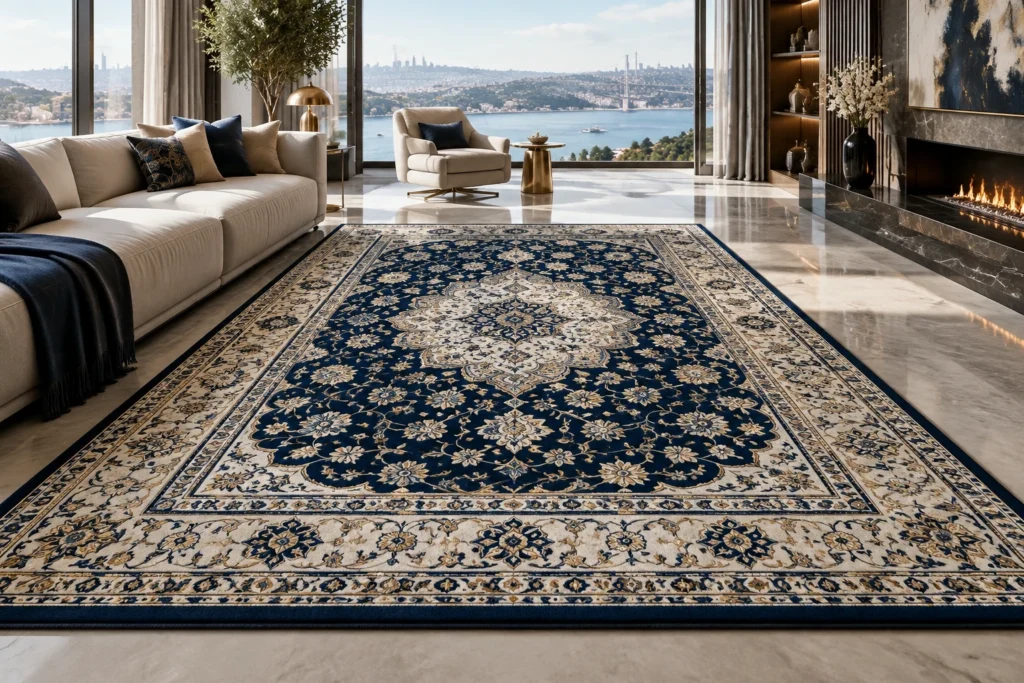
Turkey is not only recognized as one of the key manufacturers and players in the international textile market; it is also a massive consumer with a dynamic, sophisticated, and trend-conscious market. Engaging with such a market requires strategic precision, as the end consumer in Turkey pays particular attention to visual details, the harmony of the rug with modern furniture, and the sense of tranquility in the living space. Textile industry professionals and exporters looking to expand their footprint in this region must decode the visual preferences of their audience before making any logistical moves.
Determining the most suitable carpet designs for Turkish market is the fine line between a successful commercial shipment and a stagnant collection sitting in a warehouse. Shifts in lifestyle in major cities such as Istanbul, Izmir, and Ankara have driven a transition away from dense, traditional rugs with highly saturated colors toward designs that make spaces appear more open, modern, and minimalist. This article aims to analyze the dominant pattern trends, popular color palettes, consumer psychology in interior decor, and design standards required for successful entry into the Turkish flooring market.
To answer the question of which styles are in demand and which carpet designs for Turkish market are truly suitable, one must first understand the lifestyle of Turkish families and contemporary residential architecture. Over the past two decades, housing structures in Turkish cities have shifted from large, traditional villas to modern apartments and residential towers. This structural change has steered interior architecture toward Scandinavian, modern, Japandi, and fusion styles.
In such spaces, a rug is no longer an isolated work of art meant to command all attention; rather, it serves as a harmonizing element and a foundational canvas for furniture arrangement. Consumers in Turkey look for rugs that:
Therefore, evaluating carpet designs for Turkish market without considering the interior architecture and contemporary furniture layouts of the country is simply not feasible.
By analyzing major retail catalogs and contemporary interior projects in Turkey, we can observe that design diversity is centered around four main pillars:
The Turkish consumer has a profound appreciation for history, but there is little appetite for repeating past styles with saturated colors. This is where distressed-effect rugs come into play. In these designs, traditional floral scrolls, medallions, and corner motifs are rendered as if they have weathered the passage of time—faded, worn, and sophisticated. Mottled textures, hazy hatching, and irregular shading allow these rugs to blend seamlessly into modern spaces as museum-quality artifacts. This style is the most attractive option for the urban middle and upper class who seek to fuse authenticity with modern decor.
The younger generation and owners of new-build apartments show a strong preference for geometric patterns. These designs feature intricate interlocking diamonds with fine lines, subtle plaids, asymmetrical abstract curves, and continuous free-flowing lines. The hallmark of this category is its understated simplicity. By preserving negative space and avoiding unnecessary detailing, designers can offer a sense of vibrancy and openness to the audience.
In market segments that prefer more luxurious or semi-classical decor, neo-classical rugs are an ideal response. The fundamental difference between these designs and traditional classical rugs is the restraint of intricate details. Multi-layered, wide borders are transformed into fine, subtle lines, or removed entirely. The central medallion, if present, is crafted with extreme delicacy, low color contrast, and ample negative space, allowing it to sit gracefully within the layout.
Another style that has seen significant growth in Turkey is the all-over pattern without a specific focal point. Designs mimicking marble textures, ocean waves, crushed concrete, desert sands, or blurred atmospheric clouds that cover the entire surface of the rug allow decorators to place furniture without worrying about centering a medallion.
Color in Turkey is often even more critical than pattern. Even the most modern, well-structured design will fail to gain traction in the market if the color palette is off. The prevailing color trends for carpet designs for Turkish market include the following components:
It is essential for industry professionals to clearly distinguish the tastes of a consumer rooted in traditional Iranian style from those of a contemporary consumer in the Turkish market.
In the traditional Iranian perspective, a rug is often valued for its density and the richness of its intricate, sprawling floral and paisley motifs. The use of bold contrasting colors, wide bordered frames, and powerful, prominent medallions is standard for creating a sense of “fullness” in a room.
Conversely, consumer taste in the Turkish market is based on the concept of “minimalism and monochrome.” In the ideal carpet designs for Turkish market, the designer intentionally leaves sections of the background open, breaks the boundaries of the border, and utilizes subtle tonal variations (shades of the same color) rather than harsh contrasts. Essentially, the rug in the Turkish market plays a harmonic, tranquil role and must not distract from other decorative elements in the room.
Adapting a design for this market requires mastery of production processes, material selection, and precise finishing. Manufacturers designing specifically for this climate know that color shades must have high lightfastness and must not possess an undesirable or “plastic” shine.
Reputable industrial groups, including Senobar Carpet, consistently emphasize that successfully transferring a design from a digital file to the rug surface requires adjusting pile proportions, selecting appropriate yarn counts, and fine-tuning weaving machinery. Shed-free properties, soft hand-feel, dimensional stability, and professional finishing—such as precise shearing and high-quality fringe stitching or leather binding—multiply the value of the design in the eyes of international traders.
In the process of developing collections, centers like Senobar Carpet, by analyzing field feedback and monitoring regional exhibition trends, strive to maintain a technical balance between structural durability and the softness of minimalist patterns to ensure the final product meets the quality standards expected by buyers in this sector.
Selecting and developing the right carpet designs for Turkish market requires an informed, flexible, and market-driven approach. The widespread reception of vintage distressed maps, minimalist geometric patterns, neo-classical structures with open spaces, and neutral grey and beige palettes indicates that the Turkish market perceives flooring as a harmonizing, calming foundation. Exporters, traders, and manufacturers of machine-made carpets can secure a distinct and successful position in their trade relations with Turkey by moving away from busy traditional styles and shifting toward gentle, monochrome, and creative reinterpretations of classic motifs.
Understanding the visual behavior of the Eurasian and Turkish markets is a specialized and dynamic process. At Senobar Carpet, we always welcome the exchange of expert viewpoints, the review of design files, and collaborative discussions regarding how to adapt designs to the capabilities of weaving machinery. If you are a trade professional, designer, or partner in the textile industry interested in exploring technical aspects, weaving nuances, or discussing the adaptation of export-oriented designs, our technical experts are ready to share their manufacturing experiences with you in a professional setting.
