
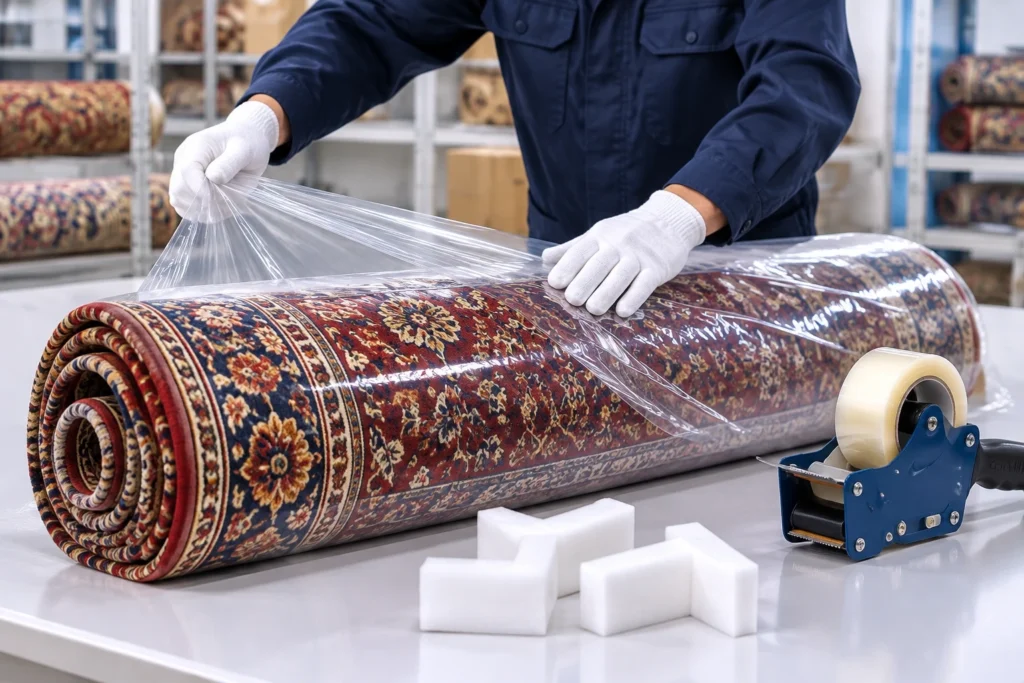
A carpet that is perfect and clean at the factory may arrive at the buyer’s destination with damaged edges, moisture stains, or torn packaging after a long journey. In exports, product quality must be maintained until the moment of delivery; therefore, the method of carpet packaging for export cannot be left to a hasty decision at the end of production. Efficient carpet packaging for export is an essential part of sales planning and must be harmonized with the carpet’s characteristics, the shipping method, and the buyer’s expectations.
There is no single method suitable for every order. Carpet dimensions, yarn type, backing structure, the number of pieces, shipping duration, and the frequency of handling determine how the carpet should be rolled, what layers should be placed around it, and whether it requires a carton or a pallet. In this guide, we examine the steps of carpet packaging for export, from product inspection to final cargo control.
In domestic sales, the distance and delivery time are usually shorter; however, an export shipment may be handled multiple times in warehouses, trucks, ports, or distribution centers. Every transfer increases the likelihood of impact, dragging the package on the ground, or damage to the outer covering. Temperature and humidity changes, especially on long routes, must also be considered when choosing the method of protection.
The goal of carpet packaging for export is not merely to cover the surface of the carpet. The package must protect the product, allow for the identification of each roll, facilitate safe transport, and allow the buyer to reconcile the shipment contents with the packing list. A package that is sturdy but damages the carpet’s fringe or edges when opened is not a suitable package.
The first step is controlling the carpet before it enters the packaging line. Examine the surface, edges, fringes, and the back of the carpet for stains, tears, loose threads, or finishing defects. Carpets that need cleaning should be rectified before covering; once the roll is sealed, identifying the source of damage becomes much more difficult. The workspace and packaging tools must also be clean and dry.
In the carpet packaging for export program, recording the specifications of each piece helps reduce errors: the design code, color, dimensions, material, quantity, and order number must be identical to the information registered for the shipment. For multi-design or multi-size orders, it is better to segregate products before rolling, rather than when all rolls appear identical.
If the carpet has been washed or is damp for any reason, wait until it is properly dried. Wrapping a damp carpet in a low-permeability cover can trap moisture inside the package and increase the likelihood of odor or damage. A dry surface appearance is not always sufficient to judge the moisture level of the backing or denser sections.
For many carpets, rolling is more suitable than folding, as severe folding can affect the texture or the back of the carpet. However, the tightness of the roll should not be determined solely by the goal of volume reduction. A roll that is too tight may put pressure on the edges, fringes, or the structure of certain products. The appropriate roll diameter must be selected according to the type of carpet and the technical guidelines for that specific product.
In carpet packaging for export, the direction of rolling should not be assumed to be identical for all models. The way the surface and back of the carpet are positioned depends on the weave structure, the type of backing, surface sensitivity, and the manufacturer’s recommended method. Before implementing a method for an entire order, test it on a sample and check the condition of the surface, edges, and back after unrolling.
Arrange the fringes before rolling so they do not get caught between layers or hang out from the two ends of the roll. To maintain the package shape, you can use appropriate fasteners or straps, but direct contact of a rough strap with the carpet surface and excessive pressure on a single point may cause marks or deformation. Placing a protective layer under the strap’s contact point is a way to mitigate this risk.
Material selection should start with the problem they are intended to solve. A clean inner layer compatible with the product protects the carpet surface from direct contact with the outer cover. A resistant outer cover reduces the likelihood of tearing due to abrasion. If necessary, end-of-roll protectors, cartons, or cushioning layers can protect vulnerable sections.
Common materials used in carpet packaging for export include protective wraps, packaging film, straps, edge protectors, and cartons; however, using all of them simultaneously is not necessary for every order. For example, the packaging of a large carpet moved by a forklift may differ from the packaging of a small rug sent as a single sale. The main criterion is sufficient protection for the actual transport route, not increasing the number of layers without a clear purpose.
The two ends of the roll are sensitive points of the package. If only the body of the roll is covered, dust or moisture can enter from the ends, and the edge of the carpet may be damaged when hitting hard surfaces. Choose the end-covering type so that it does not detach during handling and does not require cutting too close to the carpet itself for opening.
Plastic cover can be useful against dirt and accidental water contact, but it is not a substitute for the carpet and loading environment being dry. If the carpet or packaging materials are damp from the start, wrapping them completely may trap moisture inside the package. Furthermore, a cover that is weak against abrasion will tear quickly when dragged on the floor or in contact with other rolls.
For carpet packaging for export, a balance must be struck between protection against moisture and the actual condition of the product. Before selecting the final layer, examine warehouse conditions, waiting time until loading, the transport route, and the potential for temperature fluctuations. If desiccants are to be used in the package or container, the amount and placement must be appropriate for transport conditions; desiccants are not a solution to compensate for a damp carpet or a leaking container.
In sea freight, the duration of the route and the likelihood of temperature and humidity changes become more important. The condition of the container, the dryness of the floor and walls, the way rolls are stacked, and cargo securing must be checked before closing the doors. If rolls shift during transit or lean against a damaged container wall, even a good initial cover might not be enough.
In land freight, the number of loading and unloading times, the quality of the transport vehicle, and the method of stabilizing the cargo are important. Carpet packaging for export using this method must be resistant to abrasion and pressure caused by improper stacking. Heavy rolls should not be placed on lighter rolls without checking the weight tolerance of the packages.
In air freight, the weight and dimensions of the package significantly impact costs. Therefore, a balance must be struck between the weight of the covering and the level of protection. Reducing necessary layers just to save weight may eventually lead to damage costs. Before mass-producing packages, check the dimensional limitations and the delivery method accepted by the carrier.
Cartons can be useful for small rugs, retail packages, or orders that need to be identified individually in a warehouse. However, the carton must be sized appropriately to the product: too much empty space allows the goods to move inside the package, and a carton that is too tight can put pressure on the roll. For large carpets, a rolled package with proper protection may be more practical.
A pallet becomes useful when the shipment needs to be moved with handling equipment or when multiple packages are to be kept together as a single transport unit. In carpet packaging for export, the pallet must be sound, appropriate for the weight of the load, and free of sharp parts or breakages. Packages should also not be stacked in a way that they overhang the edge of the pallet or have the potential to fall during movement.
If pallets, boxes, or blocking pieces made of raw wood are used in international trade, the requirements for wood packaging in the destination country must be checked. The ISPM 15 standard applies to many types of raw wood packaging, and processed wood—such as plywood, which is made entirely of processed materials—is not within its scope. Before shipping, ensure the wood is suitable and the necessary marks are legible.
The outer label should help the warehouse manager and the buyer identify the package without opening it. Order number, product or design code, color, dimensions, number of pieces in the package, package number out of the total shipment, and gross weight are pieces of information that can be included depending on transaction needs. If carpets are prepared for multiple buyers or multiple destinations, the destination code must also be clearly specified.
The accuracy of information in carpet packaging for export is as important as the strength of the covering. The information on the label must be consistent with the invoice, packing list, and the actual content of each package. Place the label in a spot that remains visible as much as possible after stacking and will not easily become illegible due to contact or moisture typical of the transport process.
For diverse orders, preparing an accurate packing list helps each roll stay linked to its own specifications. Recording the package number and its contents, in addition to speeding up delivery, is also useful when handling claims of shortage or damage. Senobar Carpet Factory can simplify the control of multi-model shipments by standardizing product codes on labels and order documents.
Packaging work does not end with sealing the last roll. Before loading, inspect the floor and the interior of the transport vehicle for moisture, dirt, sharp edges, and signs of damage. Rolls should be positioned so that the weight of the load is not concentrated improperly on a single package and the cargo does not shift during turns, braking, or container movement.
In practice, the quality of carpet packaging for export is also dependent on load securing. Avoid large gaps between packages and leaning rolls against surfaces that can cause damage. The choice of strapping, dividers, or securing devices should be appropriate for the weight and shape of the cargo. Load securing should not be so tight that the strap or tool itself exerts point pressure on the carpet.
Before sealing or delivering to the carrier, take photos of the package status and stacking method and reconcile the number of packages with the final list. This documentation is not a substitute for inspection, but it helps clarify the status of the cargo at the time of delivery.
To calculate the cost, do not just sum the price of covers and cartons. Consumables, labor time, equipment, occupied space, pallet costs, and the effect of final weight and dimensions on freight charges are all important. Sometimes a seemingly cheap package is not the right economic choice due to high volume or a higher probability of damage.
Before finalizing the carpet packaging for export method, build a real sample and measure its weight, diameter, length, and strength. Then check whether the package stacks well in the transport vehicle and whether the buyer can open it without damaging the product. For recurring orders, recording the result of this test helps maintain consistent quality.
One mistake is treating all products the same. Carpets with different dimensions, backings, or structures may require different roll diameters and levels of protection. Another mistake is sealing the carpet before fully verifying dryness or using a resistant outer cover over an untidy inner package; the outer layer cannot correct defects inside the roll.
In carpet packaging for export, overtightening straps, leaving the two ends of the roll open, using a damaged pallet, and incomplete labeling can also cause problems. Furthermore, the appearance of the package at the time of leaving the factory should not be the only criterion. The key question is what condition the package will be in after the transport route, several handling stages, and being opened at the destination.
Before delivering the shipment, control these items for each order:
Executing this checklist transforms carpet packaging for export from a subjective task into a controllable process. In large orders, it is better to have one person responsible for the final approval of packages to minimize discrepancies between the production, warehouse, and shipping departments.
Must export carpets always be rolled?
No. Rolling is a suitable method for many carpets, but the final decision depends on the product structure, dimensions, and transport conditions. If another method is proposed, its effect on the appearance, back, and edges of the carpet must first be tested with a sample.
Does every export carpet need a pallet?
No. The need for a pallet depends on the number and weight of packages, the handling method, and the agreement with the buyer or carrier. In carpet packaging for export, a pallet is a tool for better transport and stacking, not a substitute for the protection of the roll itself.
Does using thick nylon make the carpet completely safe against moisture?
No. An outer cover helps against direct contact and dirt, but a damp carpet, damp packaging materials, or a transport vehicle with leaks are still risky. Preventing moisture damage starts with the product being dry and checking the loading conditions.
A good export package must be designed appropriate to the carpet itself and its route to the buyer. Pre-packaging inspection, proper rolling, protection of surfaces and edges, selection of suitable materials, accurate labeling, and safe stacking are links in a single process. Carpet packaging for export is successful when the product not only leaves the factory soundly but also arrives at the buyer’s hands sound, identifiable, and ready for display. Senobar Carpet Factory can also make the delivery quality of export orders more consistent by recording the appropriate packaging method for each product group.

One Response