
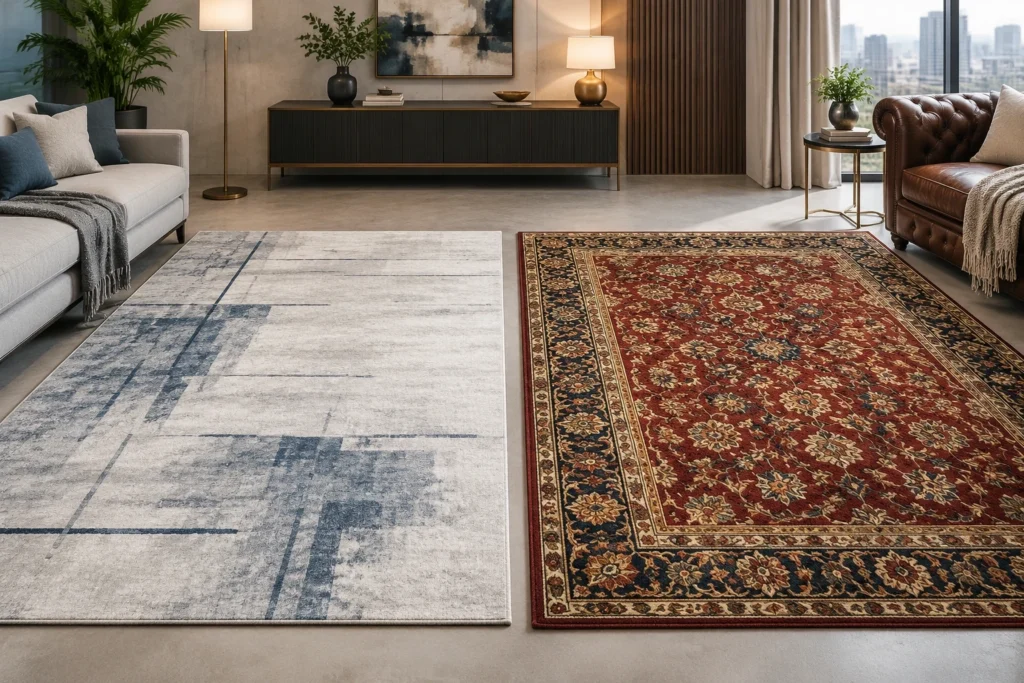
The European market is one of the most complex yet profitable export destinations for the machine-made and handmade carpet industry. However, treating the European continent as a monolithic entity is a major commercial marketing error. Every European nation has distinct purchasing behaviors based on cultural roots, climate, residential architectural styles, and consumer psychology. Among these, Germany and Italy stand out as the definitive trendsetters for consumer demand in Central and Southern Europe.
Understanding German vs Italian carpet preferences is a strategic necessity for manufacturers, exporters, and designers. The German buyer looks at the product through a lens of rationality, functionality, sustainability, and precision, whereas the Italian consumer evaluates carpets through the prism of pure art, bold statements in interior design, avant-garde aesthetics, and luxurious harmony. Recognizing these deep distinctions is crucial for successful targeted exports and selecting the right collections for these two major European markets.
To truly grasp the differences in German vs Italian carpet preferences, we must first understand the intellectual foundations of interior design in their homes:
In German culture, the legacy of the Bauhaus movement remains vibrant in architecture and interior design: “Form follows function.” The German consumer chooses a carpet primarily to provide acoustic insulation, warmth, ease of maintenance, and high durability. Factors such as ecological standards (Sustainability), certifications ensuring no harmful chemicals are used, recyclability, and compatibility with underfloor heating systems—common in most German homes—play a vital role in the final purchasing decision regarding German vs Italian carpet preferences.
Conversely, Italy is the global capital of fashion, art, and design. In this climate, a home is a showcase of aesthetic sensitivity, creativity, and subtle luxury. The Italian consumer seeks visual surprise, complex harmony between light and texture, and opulent materials. In this perspective, a carpet in an Italian home is not just floor covering; it is a visual signature that completes the architectural identity of the space, a key differentiator in German vs Italian carpet preferences.
Since the visual and technical structures of these two markets have fundamental differences, we can compare the core components of German vs Italian carpet preferences as follows:
Lifestyle significantly impacts the best-selling patterns regarding German vs Italian carpet preferences:
Best-sellers in Germany: Geometric Order and Integrated Textures
In the German market, designs that offer breathing room and avoid visual clutter take the lead:
Trending Patterns in Italy: Fusion Splendor and Contemporary Creativity
Italians are not afraid of boldness in form and pattern, which creates a sharp contrast in German vs Italian carpet preferences:
The color palette is one of the most obvious points of distinction in German vs Italian carpet preferences:
Producing products based on a comprehensive understanding of German vs Italian carpet preferences requires strictly following different technical requirements in spinning, weaving, and finishing:
1. Fibers and Finishing for the German Market
In the German market, high-quality heat-set polypropylene, naturally processed wool, and lint-free micro-chromatic yarns are preferred. The pile density must ensure the necessary compactness and stability against daily foot traffic. Possessing certifications like Oeko-Tex and tests ensuring no volatile organic compounds (VOC) emissions are of great importance to the discerning German buyer.
2. Fibers and Finishing for the Italian Market
In the Italian market, the use of shiny polyester fibers, artificial silk (Modal/Viscose/Bamboo Silk), and high-density acrylics is essential to convey a sense of luxury and an ultra-soft touch. The final finishing, the type of edge leathering, and hand-woven-like fringes must be executed flawlessly.
Leading industrial groups, including Senobar Carpet, by intelligently separating production lines and precisely adjusting yarn counts, reed density, and finishing systems, design exclusive collections tailored to the strict standards of the German market and the design-driven taste of the Italian market, consistently meeting the diverse German vs Italian carpet preferences.
To succeed in sales and respond to German vs Italian carpet preferences, exporters should adopt the following strategies:
Developing such initiatives in the management structure of centers like Senobar Carpet has paved the way for sustainable interaction with international traders and responding to the variety of tastes across Europe.
A correct, unbiased understanding of German vs Italian carpet preferences is the key to sustainable entry and market share expansion in modern Europe. The German market seeks purity, flawless technical quality, environmental sustainability, and minimalist calm, while the Italian market pursues luxury, bold form combinations, neoclassical brilliance, and architectural statements in home decor. Aligning production collections with these two distinct poles, based on a precise knowledge of German vs Italian carpet preferences, will guarantee commercial success and brand longevity in the competitive international flooring arena.
