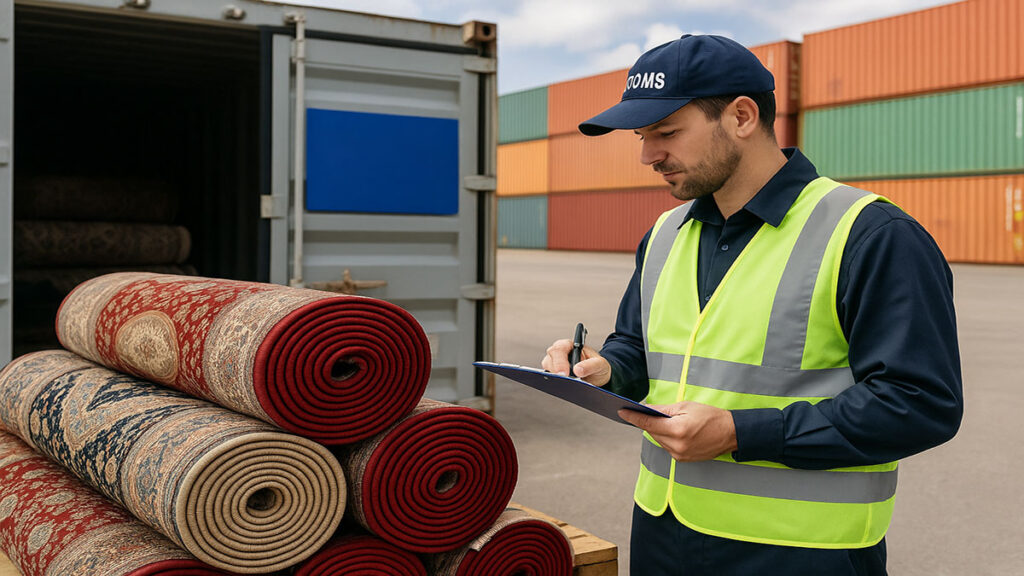
Customs clearance in the destination country is one of the most important and specialized stages of carpet export. Contrary to common belief, exporting does not end with shipping the goods from Iran; in fact, the real process of international trade is only completed when your shipment successfully passes through customs in the destination country and reaches the buyer.
Persian carpets, especially in sensitive markets such as the European Union, Canada, or the Persian Gulf countries, must go through strict documentation, technical, and customs filters. Any deficiency in documents, inconsistencies in information, or failure to meet standard requirements can lead to delays, fines, or even the return of the goods.
In this article, as the eighth step of the machine-made carpet export process, we examine all the key points related to carpet clearance in the customs of the destination country—from preparing documents to working with professional customs brokers and avoiding potential problems.
If you have not yet reviewed the previous steps, such as packaging and transportation of export carpets or international payment methods, we suggest going through those stages first for a complete and integrated export journey.
After shipping machine-made carpets from Iran, the goods must be cleared at customs in the destination country. While it may seem simple, this is actually one of the most sensitive export stages, because any document defect, misinformation, or discrepancy can result in delays, penalties, or even returns.
Particularly in countries with strict regulations such as Germany, France, Canada, and other EU nations, carpet clearance requires precise forecasting and full coordination with local customs brokers.
One of the most common issues in customs clearance is inconsistency between documents. The information on the bill of lading, packing list, commercial invoice, and certificate of origin must all perfectly match. Even slight differences (such as packaging type or final weight) can cause legal problems.
Practical advice:
Before final shipment, review all documents with an export expert and send a final copy to the buyer and destination customs broker.
Depending on the destination country, you may need specific certificates for importing machine-made carpets. Some of these include:
CE marking for exports to Europe
ISO or product quality certificates
Health or disinfection certificate (required in some African countries)
Technical specifications translated into the official language of the destination country
Example:
For exports to Germany, the carpet must not only have the CE label but also be free of harmful chemicals and come with a laboratory test report.
If your carpet is shipped via reputable international companies such as DHL Freight, Maersk, DB Schenker, or Aramex, these companies often offer customs services as well. Working with them ensures a faster, more transparent clearance process with minimal errors.
Also, having a representative or licensed customs broker in the destination country (especially for frequent shipments) can help reduce costs and avoid penalties.
In countries like the UAE or Oman, which have strong trade ties with Iran, Iranian firms operating in Dubai or Muscat can be used to handle customs clearance and then forward the carpet to other countries.
Customs clearance in the destination country is a stage that can either secure the result of all your previous efforts—or halt the export process entirely. Common mistakes such as mismatched documents, missing permits, or selecting the wrong shipping company can result in heavy costs for the exporter.
By strictly following the points outlined in this article—such as document consistency, obtaining necessary certificates, working with reputable logistics companies, and using a local customs broker—you can complete the clearance process smoothly and quickly.
Don’t forget:
Success in carpet export depends not only on product quality but also on proper management of all steps from production to final delivery.
Final Summary: The Complete Path to Successful Carpet Export from Iran
Exporting Iranian machine-made carpets is not just a simple goods transaction—it’s a multi-stage, specialized chain that requires an understanding of global markets, knowledge of international laws, mastery of financial and technical matters, and the use of modern tools.
In this article, we provided a complete and practical roadmap to success in this trade through the 8 main steps of carpet export—from choosing the target market to final customs clearance in the destination country.
Market Analysis & Country Selection
→ Analyze demand, consumer culture, competitors, and financial capacity of target markets.
Obtain a Business Card or Partner with Pro Exporters
→ Legal requirements for starting official exports.
Product Standardization & Market Preparation
→ Adjust design, size, color, and packaging to match target market culture.
Prepare Export Documents
→ Including proforma, final invoice, packing list, certificate of origin, and necessary permits.
Find Foreign Buyers & Negotiate Professionally
→ Through B2B platforms, exhibitions, and targeted advertising.
Manage International Payments & Currency Receipt
→ Using money exchangers, cryptocurrency, or company accounts in third countries.
Professional Packaging & Transportation
→ Choose the most suitable method (air, sea, land) and use durable packaging.
Customs Clearance in Destination Country
→ Work with local brokers and fully comply with import regulations of the destination country.
If you’re aiming to build a stable and profitable export operation, more than just high-quality carpets are required—you need full control over every stage of this chain. Brands that professionally manage the entire export process, from marketing to logistics and after-sales services, not only survive in global markets but also become respected names in the carpet industry.