
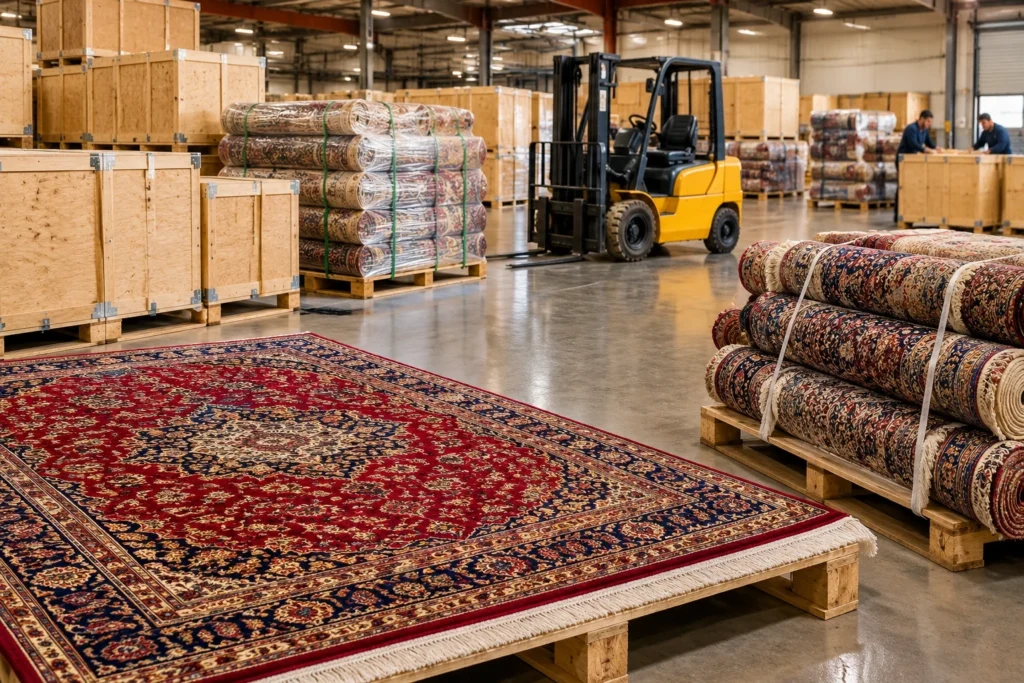
The textile and carpet manufacturing industry in Iran, particularly in the high-density machine-woven sector and exquisite handmade carpets, stands as a cornerstone of the nation’s non-oil exports. Iran’s strategic geographic location, advanced weaving technologies, fiber engineering, and authentic designs have created a continuous demand across Persian Gulf markets, Central Asia, Europe, and Africa. However, succeeding in foreign markets relies not merely on weaving quality; it requires traders to master the complete carpet export process from Iran, complex customs regulations, currency repatriation policies, and international standard logistics.
Thorough and operational knowledge of the export supply chain prevents demurrage costs, border delays, tax penalties resulting from unfulfilled currency commitments, and physical damage to goods during transit. This professional guide examines all essential steps and legal requirements to execute the carpet export process from Iran flawlessly.
The first stage of the carpet export process from Iran involves establishing the company’s legal infrastructure and conducting targeted export market research. Exporting without analyzing international buyer behavior carries high capital liquidity risks.
To enter foreign trade, the primary legal requirement is a valid “Trading Card” (Cart-e Bazargani) issued by the Chamber of Commerce, Industries, Mines, and Agriculture, approved by the Ministry of Industry, Mine, and Trade via the Comprehensive Trade System. While corporate or individual cards entail varying tax obligations, corporate entities secure greater stability and customs facilitation for large-scale carpet exports.
Traders must evaluate destination market standards before loading:
Following verbal agreements, issuing a proforma invoice is the first binding document in executing the carpet export process from Iran, detailing:
Financial management and currency commitment fulfillment represent critical administrative bottlenecks in the carpet export process from Iran, where negligence can lead to commercial bans and suspended trading cards.
All exporters must register transactions, warehouse inventories, and cargo movements in the Comprehensive Trade System (NTSW). HS codes for machine-woven carpets (typically headings 5702 and 5703) are entered here for initial declaration. Aligning registered codes with cargo readiness prevents red-channel customs inspections.
Under Central Bank regulations, exporters must return foreign exchange earnings within stipulated legal deadlines. Approved legal mechanisms for repatriating carpet export currency include:
International transport exposes carpets to moisture, tension, layer pressure, and climatic shifts. Improper packaging damages rolls and lowers commercial standing at destination ports.
Loading 20-foot or 40-foot containers and transit trailers requires engineering calculations:
The operational phase of the carpet export process from Iran involves physical entry, evaluation, duty payment, and exit permits managed via the Electronic Customs System (EPL).
Upon arrival at specialized textile customs, electronic export declarations are submitted. Following data validation, the system assigns a unique tracking number known as a “Kottaj” number, serving as the core file identifier until final clearance.
Customs assigns cargo to one of three risk-management lanes:
After customs container sealing and permit issuance, final documents are prepared for the buyer:
Transport selection depends on destination, cargo value, volume, and contract delivery deadlines. Logistics directly impacts total costs within the carpet export process from Iran.
Ideal for neighboring nations like Iraq, Turkey, Azerbaijan, Armenia, and CIS countries, enabling direct door-to-door delivery without intermediate terminal transshipment.
For distant destinations like Chinese, Indian, African, or Australian ports, container shipping via southern Iranian ports (especially Shahid Rajaei) is standard. Moisture-proof containers or industrial silica gel packets prevent humidity damage during long sea voyages.
Utilized primarily for commercial pre-contract samples or high-value, lightweight handmade silk carpets, offering unmatched speed at a higher cost.
In competitive global markets, timely delivery, color uniformity, and order flexibility define success. A successful export chain relies on direct cooperation between traders and advanced manufacturing centers.
Modern weaving facilities—including Senobar Carpet factory, equipped with advanced European machinery (such as Van de Wiele HCI and UCL), 100% heat-set shed-free acrylic yarns, and rigorous quality controls—pave the way for smooth merchant exports. The presence of industrial groups like Senobar Carpet in the production cycle guarantees compliance with lightfastness, weft tensile strength, and wash-fastness standards rigorously tested by destination customs.
The exporter’s mission concludes when cargo clears destination customs and reaches the client’s warehouse. Exporters must heed importing nation protocols:
Sustainable export success in the global machine-woven and handmade carpet market transcends simple commercial transactions; it demands engineering mastery over legal, customs, currency, and logistical chains. From obtaining trading cards and drafting precise proformas tailored to target standards, to platform registrations, Kottaj acquisition, and industrial packaging adherence to prevent physical and moisture damage, every interconnected link protects profitability.
Partnering with capable and standardized manufacturing units like Senobar Carpet, which provide bulk supply infrastructure, weaving uniformity, and global standard compliance, represents the ultimate competitive edge for traders. Relying on up-to-date customs procedures and currency obligations cements the prestigious standing of authentic Iranian carpets worldwide.
