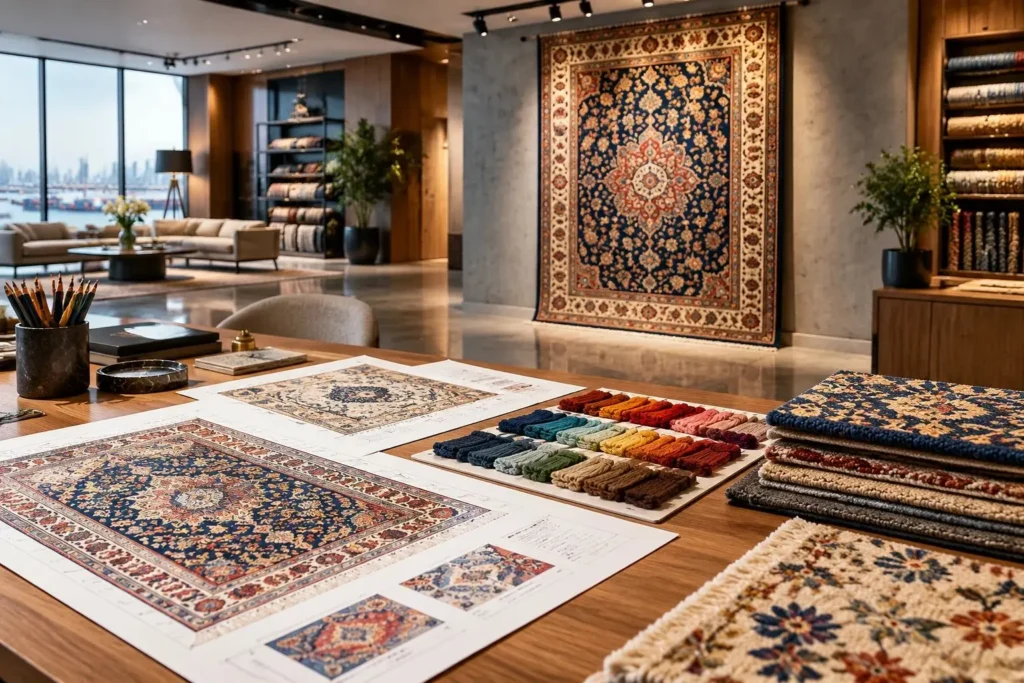
Introduction and Strategic Importance of Customization in Carpet Export
Today, the export of machine-made and handmade rugs in international trade has evolved far beyond the traditional model of “selling ready-made patterns available in stock.” Wholesale buyers, interior design studios, hotel chains, and international traders increasingly demand floor coverings that correspond precisely to the local lifestyles, aesthetic values, regional climates, and environmental regulations of their respective territories. In such an evolving environment, mastering the workflow of custom carpet design for export has emerged as the definitive competitive advantage for market-leading manufacturers.
When an industrial facility provides bespoke color matching, non-standard dimensions, pile height alterations, and fiber selections tailored to the demands of international clients, it safeguards its profit margins and transcends destructive price wars. Achieving long-term success in executing custom carpet design for export projects demands a comprehensive understanding of destination market psychology, rigorous textile testing standards, and seamless synchronization between the creative studio and high-speed weaving looms. In this article, we thoroughly analyze the multi-layered process of engineering bespoke carpets for exclusive and luxury markets worldwide.
arget Market Analysis: Harmonizing Patterns with Cultural and Architectural Preferences
International marketing cannot rely on a generic, one-size-fits-all approach. The foundational stage of custom carpet design for export involves performing an aesthetic and architectural analysis of the target market:
- Western Europe and the Scandinavian interior design sector: Consumers in this territory show strong dedication to minimalism, organic contours, distressed textures (vintage and abstract motifs), and subtle harmony with natural lighting. Neutral color schemes featuring ivory, warm grey, beige, and slate with short-to-medium pile heights command the highest demand.
- Gulf Cooperation Council (GCC) and the Middle East: In this territory, classical authenticity, ultra-high knot densities (such as 1200 and 1500 reeds/picks collections), full medallion configurations, and opulent palettes (navy blue, burgundy, olive green, and antique gold) combined with silk-like softness remain highly coveted. Palace refurbishments, grand mosques, and luxury villas continuously require oversized, seamless bespoke carpets.
- North America and Canada: Purchasing decisions in this region center on transitional, rustic, neoclassical, and geometric layouts featuring charcoal, cream, and warm taupe tones. Moreover, flammability safety ratings and hypoallergenic certifications represent decisive criteria for commercial and residential buyers.
- Russia and Central Asian markets: Cold climatic conditions generate high interest in heavy, high-thickness pile rugs featuring transitional modern-classic patterns with embossed floral relief, delivering reliable thermal insulation alongside visual luxury.
Fiber Engineering and Raw Materials for Bespoke Export Rugs
Raw material selection within the custom carpet design for export supply chain directly reflects the installation space, customs regulations, and local environmental conditions of the client’s country:
- Heat-Set Polypropylene (BCF): Highly recommended for humid and rain-prone climates, heavy-traffic commercial floors, and importers seeking stain-resistant, antimicrobial, and cost-effective solutions.
- Microfilament and Polyester Fibers: An ideal choice for contemporary aesthetics, delivering deep velvet textures, silk-like light reflection, and zero-shedding properties suitable for consumers prone to allergies.
- High-Grade Heat-Set Acrylic: A premium fiber celebrated for its exceptional resilience, recovery under heavy weight, and traditional woolen look that performs exceptionally well in fine loom-knitted decorative rugs.
- Natural Fibers and Pure Wool: Typically reserved for high-end hospitality suites, boutique projects, and bespoke residential orders, requiring strict moth-proofing certifications and phytosanitary export documentation.
Step-by-Step Execution of Custom Manufacturing for International Buyers
Executing a flawless custom carpet design for export project involves rigorous multi-stage oversight by textile engineers:
- Design Brief and Requirements Assessment: Extracting operational parameters, including architectural usage, exact Pantone TCX/TPX color coordinates, exact metric dimensions, and target project budgets.
- 3D Simulation and In-Situ Architectural Rendering: Prior to industrial weaving, designs are digitized via professional carpet CAD systems, and realistic interior mockups are submitted for international client approval.
- Strike-Off and Laboratory Sampling (Lab-Dip): Producing compact physical swatches and sample cutouts to verify hand-feel, shade accuracy under standard D65 light sources, and mechanical pile density.
- Loom Configuration and Production Weaving: Recalibrating precision jacquard machinery according to exact reeds, picks, and pile heights specified in the commercial export contract.
- Finishing, Latex Coating, and Quality Control (QC): Millimetric dimension verification, color shade inspection, non-slip backing application, and multi-layered packaging designed to endure extended ocean freight and intermodal shipping.
In this manufacturing ecosystem, modern technological infrastructure—such as the engineering facilities at Senobar Carpet Factory—provides agile capability to convert visionary conceptual layouts into export-grade floor coverings matching exacting international quality benchmarks.
Technical Standards and Quality Compliance in Export Agreements
Sustaining a presence in demanding regional markets requires navigating mandatory regulatory frameworks throughout custom carpet design for export workflows:
- Flammability Certification: Adherence to recognized fire resistance tests (such as the Methenamine Pill Test in the USA and European EN 13501 fire classification) is vital for hospitality and public contracts.
- Color Fastness Against Light and Washing: Achieving Grade 4 or higher in light fastness ratings (ISO 105-B02) guarantees carpets withstand heavy ultraviolet exposure without premature fading.
- Chemical Safety and Non-Toxicity Accreditations: Compliance with standards such as OEKO-TEX Standard 100 confirms raw fibers, dye auxiliaries, and backing compounds remain completely free of hazardous substances or heavy metals.
- Customized Private Labeling and Packaging: Integrating client-specific barcodes (EAN/UPC), custom back-labels, and moisture-barrier vacuum packaging engineered to protect shipments from condensation throughout maritime logistics routes.
Commercial Buyer Checklist for Sourcing Bespoke Rugs
Before entering formal procurement agreements, importers and commercial purchasers should verify the following practical items:
- Have custom color recipes been systematically matched against international standard color systems?
- Has a physical pilot swatch or strike-off sample been approved prior to full production weaving?
- Do pile specifications and density ratings correspond precisely to anticipated foot traffic at the target site?
- Does export packaging guarantee full structural protection across containerized maritime transit?
- Does the manufacturing facility possess wide-width machinery capable of handling custom oversized rugs without seams?
Addressing the varied requirements of global trade through advanced manufacturing platforms makes Senobar Carpet an authoritative production partner for commercial buyers sourcing dedicated bespoke collections and international hospitality projects.
Conclusion
Offering professional custom carpet design for export constitutes the cornerstone of enduring distinctiveness in global textile commerce. Manufacturers capable of translating indigenous aesthetics from European, Middle Eastern, or North American markets into refined textile engineering secure lasting customer loyalty and sustained brand equity. By respecting local market tastes and adhering strictly to environmental and safety benchmarks, custom rug manufacturing continues to expand the frontier of international trade and value creation.